




Asian ingredients can confuse with all the various names in their native languages and then the English term(s) for them. This afternoon, Phu emailed asking for the English name for lá dứa, a common southern Viet ingredient. They’re called pandan leaf in English. They’re also called screwpine leaf, which isn’t very nice sounding!
Dứa is also the name for pineapple in Vietnamese and I once caught my father explaining to my non-Viet husband that lá dứa were the leaves of the pineapple. That’s wrong, Daddy. Stop. They’re not related! A pretty full listing of names for pandan is at wikipedia.com.
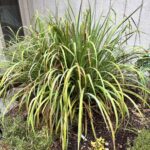
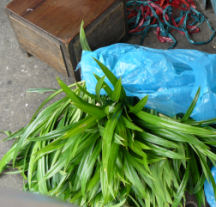
Pandan leaves (Pandanus latifolius, P. amaryllifolius) look like gladiola leaves. They’re narrow, long and pointed at the tip. When attached to their stems, they resemble giant green feather dusters. (See the top photo taken at a neighborhood wet market in Saigon last March 2008.)
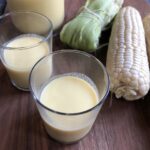
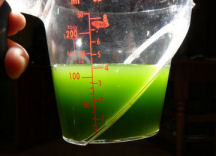
They have a grassy herby flavor and can be tied in a knot and added to rice, both long grain and sticky rice. Cooks also use them in desserts by extracting their liquid, traditionally done by pounding on the leaves but I do it in the blender or mini-chopper with a little water. The green result is striking in color, kind of like super wheat grass in smell and looks. Once cooked, the color turns to a celadon green, and there’s a subtle hint of the herby quality. Below is strained pandan juice that I got from cutting up 4 to 6 large leaves into 1-inch pieces and whirring with ½ cup water.
 Many cooks add a little green food coloring to cheer up the pandan extract but the result is a little Christmas-y to me. Pandan leaves can also be used to wrap food up in and then grilled, though I’ve not been overly impressed with that application. Pandan can be woven into small containers too.
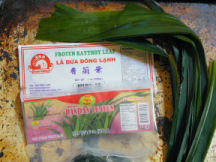
In the Vietnamese kitchen, pandan is basically a southern ingredient. I’ve seen reference to it in old cookbooks that call for lining steamer trays with the leaves and then steaming sticky rice over it for flavor. In fact, an alternative name for lá dứa is cây cơm nếp (tree for sticky rice). Abroad, pandan is mostly available frozen, though I can get fresh in San Jose and Orange County, California. Floridians have told me that the plant grows very well there.
Aside from culinary uses, it seems that pandan may be good for controlling diabetes too. That’s the latest from the Vietnamese community, per Phu who was asking about the English name for lá dứa. Drinking a tea made with pandan leaf has helped a few people combat or reduce the threat of diabetes – a growing problem among Vietnamese Americans whose diets have gotten richer and lives more sendetary since their arrival in the States. Phu will be trying it out and reporting back!
Though I watch what I eat, I frankly focus on the food more. I was raised by a mom who hailed from northern Vietnam so I'm relatively new to pandan. Over the past year or so, I've been experimenting and here are some tips:
- When using pandan for sweets, I’ve found that it marries exceptionally well with coconut milk, especially when a touch of vanilla is added to bring out the herbal quality of both the coconut milk and the pandan. Make sure to add some sugar and 1 to 2 pinches of salt.
- Use a lot of leaves or the result will just be so subtle you’ll think the leaves weren't worth the trouble.
- Try to avoid the bottled extract, which tastes of chemicals.
- Smash the leaf a little before knotting it and adding it to cook rice, etc, to ensure that the essence releases.
What are your favorite ways or tips for using the green leaf?



Jaden, Steamy Kitchen
I can only find frozen pandan leaves at my market and tried making pandan cake without using the artificial stuff, but the flavor was too subtle. Generally I just throw it in my rice cooker and steam my rice with a couple knots.
Annie
We use it in Malaysia for all kinds of applications. We use it for desserts (all the soupy desserts tend to call for at least 4-5 knotted leaves), in chendol, in cakes (matter of fact, I'm going to bake a pandan chiffon cake today--using the paste), and in savory dishes (mostly in the rice). I miss fresh pandan very much and have been tempted to buy a pot (but the asking price was just a little too hefty--$40 for a small plant). So I mostly buy the frozen kind. Sigh...not quite the same.
[eatingclub] vancouver || js
Can't seem to find pandan leaves here, but maybe I haven't been looking too hard. I've seen frozen banana leaves, but not frozen pandan. Pandan has quite a heady aroma.
Lips
we use it to ward off cockroaches too, instead of using moth balls.
Andrea Nguyen
Jaden, I'm surprised that you can't get fresh pandan in Florida! Seems like of all places that it would be available there.
Annie, when you baked your chiffon cake, how'd you use the pandan? If the recipe is on your blog, do give us the link!
Wandering Chopsticks
Well, Southerners call pineapple trai thom so there's no confusion. 🙂
Annie
Andrea, haven't posted the recipe yet but it has coconut milk and vanilla and pandan (just like you said you'd use it in desserts). Will send the link once we post it. The cake got wolfed down so quick but I'm not 100% satisfied with it (think I didn't beat the whites stiff enough) so I'm going to bake another one. Maybe I should have you over for dessert one day! ^_^
Jacqueline Church
Just discovered your blog. Good job! I have a pandan question/observation. I tried ice cream that was pandan leaf flavor and it tasted nutty to me. In fact, since I have developed a very unfortunate nut allergy, this is one of my nut-craving relief dishes.
Second question: (cheeky of me, when I've only just said hello and introduced myself, huh?) I had a delicious meal in SF tenderloin district and the menu said it was traditional "Ha Noi Food." Turtle Tower - I believe.?
Can you tell me the dif
Tuty
Andrea, whenever I made your wonderful cassava cake I use several pandan leaves to infuse its flavour while steaming the mung bean. I also steep the coconut milk with pandan before mixing it with the grated cassava. I really like how it turns out.
Nate
Hi Andrea,
Our Pandan Chiffon Cake recipe is up!
http://chezannies.blogspot.com/2009/01/pandan-chiffon-cake.html
Andrea Nguyen
Nate, I've been waiting for this cake of yours. So glad to know that the recipe is now available.
Beth
I can only find pandan extract. My recipe calls for one leaf. How much extract should I use? Thanks.
Jessica
Andrea, do you have the recipe for the pandan waffles they sell in Vietnamese bakeries? I love to make them at home. Is it possible for you to do a posting about it? Or you could email me.
Thanks 🙂
Andrea Nguyen
Jessica, just tweak this recipe for coconut waffles!
https://vietworldkitchen.com/blog/2007/08/vietnamese-coco.html
Buy Valtrex
Diabetes is a condition of interrupted sugar regulation, however specific restriction of sugar is not necessary, except for ensuring a balanced diet overall for diabetes health. Diabetes diet guidelines taken from free diabetic recipes keep count on your calories and carbohydrates and control the sugar from building up in excess in the blood of a diabetic patient.
Generic Avodart
There are various pandan leaves benefits to go along with the culinary uses of the pandan leaves. Pandan leaves are very beneficial for various health conditions. Pandan leaves consist of essential oils, traces of tannin, glycosides and alkaloids as well. As a matter of fact, whole pandan plant is considered to be diuretic and is extremely useful for healing various wounds and diseases like smallpox. Pandan leaves are said to be pain relievers and used that way to cure chest pain, headache, redu
Larney
Hi, Andrea!!
I love pandan flavor and i want to bake a cake using it but I want to know if Pandan is considered nut-free because I have a kid who has nuts allergy,and i wanna make sure if this kind of flavorings is safe to people who has food allergies specifically Nuts.
Thanks 😉
Wheatgrass and Pandan
I miss Pandan, as much as I miss wheat grass.
Michelle
???
Generic Diovan
Pandan (screwpine pandanus) is a type of tree that grows in tropical areas of Asia. Pandan leaves have a sweet, unique flavor that is commmonly used in Southeast-Asian countries to enhance both desserts and savory dishes.
arizona search engine optimization
Nice to be visiting your blog again, it has been months for me. Well this article that i've been waited for so long. I need this article to complete my assignment in the college, and it has same topic with your article. Thanks, great share.
taobao shop
He is a good friend that speaks well of us behind our backs.
*_*
cheap jordans
Good hand washing is an important way to reduce the spread of infections.
evelyn nguyen
I've been cooking la dua with artichoke (artiso, in Vietnamese) for a recipe for Nước Mát. 3 or 4 leaves of pandan with 2 or 3 medium size of artichokes add đường phèn (yellow rock sugar) for a touch of sweetness. It is DELICIOUS.
Beats by Dr Dre sale
Truth will stand without a prop.
pandanjuicer
listen woman, you need 1/2 a cup of concentrated pandan juice before you can even taste it. not some 1 tablespoon barbie doll amount...
קידום אתרי אינטרנט
I have a grassy herby taste and can be linked in a troubles and included to feed, both lengthy feed and awkward feed. Chefs also use them in candy by getting their fluid, typically done by beating on the simply leaves but I do it in the mixer.
giay da nam
They were a little fiddly to make, as there is a bit of a knack in wrapping the chicken in the pandan, however I got the hang of it after doing a few. I have to admit though, I made one hell of a mess wrapping them (hence no pics sorry, my hands were covered in marinade). I was proud as punch in my first attempt and am sure that the next time it will be a lot easier.
marlon
There are various pandan leaves benefits to go along with the culinary uses of the pandan leaves.
Arthur
Well, hate to say it but your father is right...from the northern perspective. To correct you a little bit, and it is often not your fault. You are a northerner, and ONLY northerners call pineapples "dua" (yua). So when your father said la dua is the pineapple leaf, he wasn't wrong, he was just speaking in northernese (just made that up), and didn't mean to talk about pandan leaves. For instance, northerners call a ball "bong" but the rest of the country call it "banh" (without the accent mark
Arthur
such as? would like to learn more. but where are people getting their info from? which studies or are these just anecdotal information? please be explicit as our community is less science and full of hearsays.
Jim Harper
A question, not comment! My Vietnamese wife and I were growing a plant in Hon Chong, Vietnam (South) which my wife used the leaves as an addition when making Soya milk, in the boiling process. She referred to it as Panda. Is Pandan what she is really talking about? I found that it grew very well when I dumped it in an old outdoor fish pond. It grew to a metre or so tall but a very healthy specimen. Jim Harper. Maitland, NSW, Australia.
business broadband providers
It’s a great site to see. That will help for improvisation of me. Will definitely marked as Bookmark.
Pandana Man
I've been using pandan leaves to clean the insides of my rifle as well. Fantastic stuff. I get real tired waiting for a target while on operations, so taking out a bunch of pandan leaves, and using it as toilet paper makes me feel real fresh. However, be gentle and slow while using it as toilet paper, because I ended up having a few paper cut streaks around my ass, and my wife was thinking I had a bondage session while I was out in the woods.
If I knew it was meant to be used to improve the flav
Lenny
I live in Los Angeles, ca. Do you know where can I find fresh pandan leaves? I saw frozen pandan leaves in Filipino market, but I really want to use the fresh one. You said you can get fresh pandan from Orange County, would let me know the market name, please?