



 When my family first came to the United States, we did many things the old-fashioned way. Dried mung beans are one of the most-often used legumes in Vietnamese cooking so we bought unhulled mung beans (the green ones with the skin on), soaked them, boiled them, and then laboriously rubbed off the green skins. Green papaya salad was a family favorite and my mother once made my oldest sister hand cut enough papaya to feed thirty people. We roasted raw peanuts in a dry skillet for garnishing a multitude of Vietnamese foods. We thought that such labors were common in America. After noticing the tiny bay shrimp at a local grocery store, we pondered the repetitive work involved for those whose sole occupation was to remove the shells from those shrimp. "I pity the poor people who have to do that job," my mother said.
It wasn't long before we realized that America was much more developed than our little Vietnam. Yep, we figured out that there was some sort of mechanized process for shelling bay shrimp, just like we discovered the convenience of buying hulled split mung beans, using the food processor of a shredded for green papaya, and shopping at health food stores for roasted, unsalted peanuts.
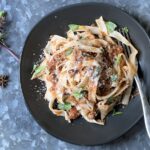
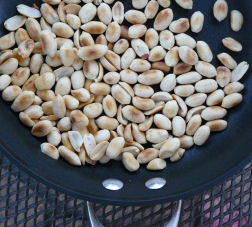
While I'll never go back to rubbing skins off of teeny mung beans and have written off hand-cutting green papaya after trying it just once, I found myself this evening pan-roasting raw peanuts. Tomorrow night, I'm cooking dinner for my dear friend James Oseland, editor in chief of Saveur magazine and author of Cradle of Flavor (a fantastic work on Indonesian, Singaporean and Malaysian home cooking), and his mother. Our main course is a turmeric catfish with dill and scallion noodle dish from Hanoi. One of the essential garnishes is whole roasted peanut.
I'd bought a half pound of raw peanuts at the Chinese market for simmering with squash and coconut milk, and the bag sat on the counter near the stove. While prepping the ingredients, I remembered my mother's description of roasting peanuts in sand to evenly cook them and I wondered if they'd taste better in the catfish dish. Surely James would appreciate/understand the effort. What the hell, I threw the peanuts into a heavy-bottomed skillet, turn the gas to medium, and went about my cooking.
When roasting nuts you want to do it slowly to ensure that the entire nut is cooked through and none of it remains raw. I remember the times when we ended up with unevenly roasted peanuts that were partially burnt because someone wasn't watching the skillet or rushed things. Out of angst, I adjusted the heat periodically and shook the skillet frequently. I was on the phone with my girlfriend Maki who asked, "What's that you're doing? Spinning plates on a stick?"
"No, I'm pan-roasting peanuts," I responded and held up the skillet close to phone so she could get an extra earful.
The peanuts were large and seemed to take forever. I'm used to toasting sesame seeds, which take no time by comparison. I kept testing the peanuts for doneness by eating them. For the most part, they were unpleasantly raw tasting. Finally, after a good 50 minutes (Maki had hung up to make dinner for her family), I turned off the heat and let them continue cooking as they cooled. They started making little cracking noises and darkened just a tad.
Once completely cooled, I did a taste test between the home roasted peanuts and the Trader Joe's stash that I kept in the freezer. The pan-roasted ones were aromatic, peanutty, but slightly bitter whereas the purchased peanuts were rich and peanutty throughout, without the bitterness. The former was more complex but the latter more pleasant on the palate.
They were two different varieties of peanuts - Trader Joe's is smaller than the Chinese market's. Vietnamese cooks don't normally fry peanuts like the Chinese and other Southeast Asian cooks do. We basically dry-roast the peanuts and frankly, they're just not that great. If you roast peanuts at home and have some kind of trick, please share it!
My conclusion? I'm sticking with store-bought and put my Vietnamese cooking efforts elsewhere. Certain modern conveniences are wonderful time savers and tasty too.



Simon Bao
Andrea, I've never roasted peanuts at home, mostly because I never buy raw peanuts - mostly because I can't abide boiled peanuts, which is what most people seem to make with them. But Alton Brown did a peanut episode, in which he covered some basics of home roasting of raw peanuts. His recipe, minus his explanations and details, is at http://www.foodnetwork.com/food/recipes/recipe/0,,FOOD_9936_75310,00.html
I do recall Alton Brown emphasizing that different varieties of peanuts yield different
marietta
Hi Andrea,
I am Indian and we use a lot of peanuts in regular cooking.In India too sand roasting is a common practice.I too have had many batches of pan roasted peanuts getting burnt after which I have discovered that roasting in the oven at about 400C is a good way of getting evenly roasted peanuts.The time would vary depending on the quantity and size of peanuts.Hope this helps.
Andrea Nguyen
Simon,maybe it's better with fresh peanuts? Btw, I like boiled peanuts -- just the plain ones boiled with some salt Asian style.
Marietta, yes, the oven method, which Alton Brown uses in Simon's link, is the best way to go. That's how I usually roast other kinds of nuts like walnuts, almonds, etc. Doing it in sand mimics an oven because of the even heat conductivity. With no sand, ugh, it's a tough go!
Joel
Hi Andrea, my Dad is a very big fan of home roasted nuts but as his health condition discourages intake of seasoned roasted nuts (with high amount of sodium) he always tries to find unsalted nuts. Often we find it is cheaper to buy uncooked nuts rather than unsalted cooked ones so we often prepare nuts at home. We use oven as it is often bigger than non-stick pans that we use at home but also there is less risk of burning the nuts using ovens.
One important thing is to briefly blanch the nuts
Andrea Nguyen
Joel,
Blanching is brilliant. You're soaking them in a sense and forcing them to open up/rehydrate before roasting. Thanks for the tip!
Marcos Gordillo
Preparing roasted peanuts at home is a very delightful. Oven must be preheated at 160C and peanuts (washed an dried) putted in a pan forming a unique layer; 20 or 25 minutes later, gold peanuts are ready; wait one hour and you can begin to taste it. As you can see, peanuts are not seasoned. Question: could somebody tell me how I do to season roasted peanuts?
Thanks a lot
Andrea Nguyen
Marcos,
Thanks for your tip! How about if you toss the peanuts in your seasoning (salt, pepper, sugar, other spices) and add a little oil so that the seasonings stick to the peanuts. Then roast them.
Here are flavor combinations from the U.S. peanut board -- which of course encourages the public to cook and eat more peanuts! There's spicy, Asian and Moroccan takes at:
http://www.nationalpeanutboard.org/recipes3.php?catID=4&recID=78
I'm sure you'll quickly get the idea. Enjoy.
Puma Clyde
These look great! I recently read a recipe in Bon Appetit that added a huge pat of butter to the inside of a burger! I'm glad to see something that doesn't rely on so much fat for flavor, haha.
chanel replica watches
To me, home is forever a joy where I can always find love, understanding, care and help.Home is where heart is !
Christian Loboutin sale
Jeans are now made with colors ranging from the usual blue and black to light brown, red, and ochre.
Mr. Cooking Grill
Great information you got here. I've been reading about this topic for one week now for my papers in school and thank God I found it here in your post.I had a great time watching and reading this.
marlon
These look great! I recently read a recipe in Bon Appetit that added a huge pat of butter to the inside of a burger!
James
I just bought some shelled peanuts at the Asian market that still have the red skins on them. I was wondering what's the best way to remove the skins and roast them. It looks like blanching is the trick. See this link: http://www.ehow.com/how_5761149_roast-raw-shelled-peanuts.html
Haven't tried it yet so we'll see.