


Lookit, Asian people eat all kinds of plants and animals for that matter. It's hard to keep up. A Hmong farmer a while back said to me that you can eat practically everything. "There's no harm in trying," he said. The Hmong are fearless survivalists. They are people who eat fresh Sichuan peppercorns that numb your mouth and leave a biting spicy bitter taste on the palate for about 30 minutes.
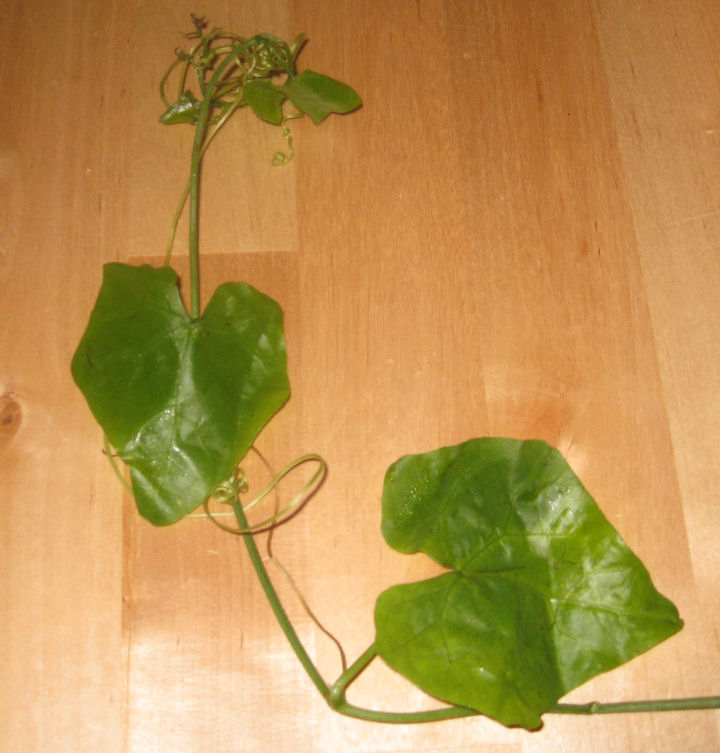
I thought of them because two people have recently asked about the same oddball vegetable lately. Elise in Massachusetts queried and then sen in the photo of what she recently bought at a Viet market in the town of Lowell. They were labeled "bass leaves."
In New York a few weeks ago, I saw packages of vines and leaves resembling Elise's bass leaves. They weren't labeled as bass leaves. My friend James Oseland, a fellow Southeast Asian food expert and editor in chief of Saveur magazine, was with me and said that they were morning glory leaves. We later got some takeout Thai food from a video store in Flushing and the leaves were in a stew/curry of sorts. I can't remember whether or not there were stems and tendrils. Overall, the vegetable didn't taste like much, nor did they impart interesting texture. On the other hand, the food was extremely spicy and could have easily overwhelmed any flavor the vegetable had.
 A few days ago, Jaden of the Steamy Kitchen blog in Florida asked about an unfamiliar, kinky Asian vegetable. She sent me one of her handsome photos of a seared scallop dish thay she prepared and set atop the vegetable in question. At first I thought the kinky veggie was curled up water spinach stems (rau muong) but she had some large, heart shaped leaves in the bowl.
So what do you folks on the East Coast have? I do think that it's morning glory vine and leaves, as James identified. Morning glory belongs to the huge Ipomoea family comprising of 500 different species. They grow very very quickly and have pretty trumpet-shaped flowers. Most gardeners think of them as weedy pests and like to grow them in containers to control the vines. But Ipomoea plants aren't ornamental. In fact, sweet potatoes are members of that genus.
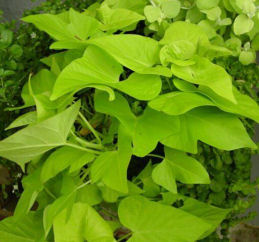
Guess who grows lots of sweet potatoes (Ipomoea batatas) ? Southeast Asian farmers. Typically what we see at Asian markets as "yam leaf" are non-producing sweet potato vines (see photo below). They have delicate hear-shape leaves and you stir-fry just the leaves and discard the stems. They have an earthy flavor and are slightly slimy when cooked but not offending gross.
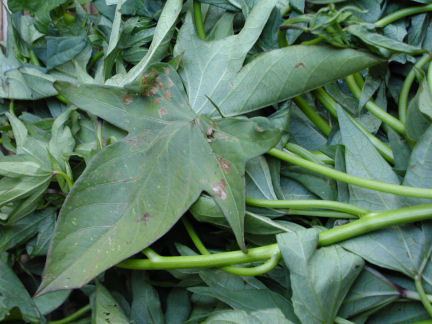
Those same farmers usually cultivate sweet potatoes too, and now is the season to harvest the potatoes for market. I suspect that they're bringing the vines too as a way to maximize their earnings. I've not seen these leaves on the West Coast but will keep an eye out. Above is a photo of a type of sweet potato plant. Below that is a typical morning glory flower.
If I were to get a hold of some, I'd try stir-frying or blanching the leaves and stems separately and see if they're flavorful.
If you're familiar with this vegetable, do share your thoughts!
11/28/07 Update: Turns out I was wrong. "Bass leaves" aren't morning glory vines. Read the comment thread to find out what they really are!



Anh
My fav way of enjoying sweet potato vine is in Canh Cua (you know the small freshwater crab). The more popular combo is rau mung toi & muop nau cua, but my grandma uses freshly picked sweet potato leaves and it is really GOOD! Serve this with some good ca` muoi (Vietnamese pickled eggplant) and I will be very happy.
My father also sometimes par-boiled them and eat with muoi vung.
I wish I could type some Vietnamese. Hope you understand what I am talking about! 🙂
Anh
My fav way of enjoying sweet potato vine is in Canh Cua (you know the small freshwater crab). The more popular combo is rau mung toi & muop nau cua, but my grandma uses freshly picked sweet potato leaves and it is really GOOD! Serve this with some good ca` muoi (Vietnamese pickled eggplant) and I will be very happy.
My father also sometimes par-boiled them and eat with muoi vung.
I wish I could type some Vietnamese. Hope you understand what I am talking about! 🙂
Simon Bao
Andrea, I came across your blog doing a Google search on the phrase "kinky vegetables."
Just kidding, but don't be surprised now if you find some very interesting and unusual guests visiting your blog in future. LOL
The photo of "Bass Leaves" at the top doesn't quite fit my idea of la khoai lang (as the second photo does). I know the leaves can come in different shapes but those still don't look like sweet potato leaves up there.
In all the world that is known to Google and other search engine
Jaden
Yes - I think that first photo is it! The kinky stems are a little shiny, light in color. Thank you Andrea!
btw, I just bought The Seventh Daughter book that you have highlighted. I can't wait to read. I also got The Last Chinese Chef.
Andrea Nguyen
To clarify and provide a point of comparison, I just added a photo of what are conventionally sold as yam or sweet potato leaves at Asian markets. They are not kinky.
Maybe Bass is a weird homonym or just a mispelling? I gut tells me that we've got a 'new' vegetable that's entering the marketplace. Thanks, Simon for circulating the unidentified vegetable.
Jaden, did you eat the leaves and kinky vines raw or cooked?
Nate
I think I prefer stir-fried sweet potato leaves over ong choy. The stems are not as fibrous.
Robyn
Northern Thais also eat fresh prickly ash - it's called makhwen and it's a different variety from Sichuan pepper corns, a bit smaller. Sumatran Batak also eat them- yet another variety, called andaliman. They pound them with lime juice, garlic, and ginger to make a dip for BBQ'd pork, and use them in another preparation with raw fish.
The top photo looks a bit like a vining veggie called dtam leung in Thai -- very popular, again, in northern Thailand, stirred into curries or stir-fried fai daeng
Jaden
I ate them raw - like in a salad. Very little taste. The pic I sent you - I had mixed napa cabbage + sweet pea leaves + mystery veg.
When I bought the bag of kinky vines at the market, it was a bag of just kinky vines. no leaves.
I've never used the word kinky so much in my life.
😉
j
btw, I just bought and downloaded a bunch of Splended Table podcasts and heard your segment! Love the analogy of Vietnam's 3 parts characterized by noodle soups. Brilliant!
Amy
In reference to the heart-shaped, viney picture at the top, I also see that leafy green in Cambodian stores all around Providence, RI. I'm not sure what it is, but it's been around since I have moved here (6-7 yrs ago), so it's something that locals like to eat. I think it's used in Thai/Laos cooking. I made the mistake of purchasing it one time and there isn't anything spectacular in terms of flavor for me. It's just a bland, heart-shaped leaf that does resemble morning glories.
But I joke
Ivy
I bought the "yam leaves" from a Laotian farmer at farmer's market before. I really enjoyed just boiling them (the leaves, not the stem) for 5 minutes and then pouring chile soy sauce over it. Tastes like rau muong, but slightly different taste and texture.
ndog
I'm in the Bay Area and been trying to find the so called "bass leaf" for years. They use it in Thai soups a lot and although not a strong flavor I find it delightful. Can you let us know if there is a specific variant of morning glory.
Andrea Nguyen
Okay, there's no flavor in those kinky vines. Jaden's eaten them raw and Amy's family cooks with them. Well, when you need food, you eat what you can get, no?
Ivy, yes, "yam leaves" are reminiscent of rau muong but the ridges on the back of the leaves give the leaves a bit of texture that rau muong water spinach leaves lack. On the other hand. you can't eat yam leaf stems as you can with the rau muong stems. Both are a tad slimy.
Andrea Nguyen
Ndog, I'll check with some local sources and let you know what the availability is in the Bay Area.
Robyn
I still wager the bass is melothria heterophylla or a close relative to it. Called phak tam ling (or phak tam nin) in Lao phak dtam leung in Thai. Identified on p. 37 of Phia Sing's 'Traditional Recipes of Lao' (ed. Alan Davidson) which is, by the way, a great reference for anyone interested in NE Thai and Lao ingredients.
Amy, sadao/sadaw is always eaten raw -- in N Thailand, with a sticky sweet chile 'jam', and also as part of the veggie/herb plate to accompany meals. I really love strong, bit
Tiffany
My mom buys the rau lang (yam or sweet potato leaves) for me almost every week from a Hispanic farmer at the Norwalk farmer's market. It costs around $1-2 for a big bunch but you can only eat the young leaves/stems and discard the rest. I love to parboil them and dip in a lime nuoc mam sauce or just saute them with lots of chopped garlic and some nuoc mam. I make canh bun cua sometimes and use rau lang as part of the vegetable medley.
In Little Saigon, we can get them most of the time at vari
Andrea Nguyen
Roby, thanks for the botanical name and the Lao reference. Without much asking, you became my expert source. Hee hee.
Ndog -- now you have a lead on how to track the stuff down.
Tiffany, thanks for the family recipe for rau lang (yam/sweet potato leaf). I loved boiled vegetables and they're what many people eat. Alas, they're not 'sexy' but I champion them nonetheless because that's what makes good, solid Vietnamese home cooking. And for that fact, any good home cooking!
Mealear
I've had the vine veg several times; I still don't know what it's called in English. I've always had it in a light-broth soup. No flavor, just different texture.
Back to sadao...27 years, and it's still a work in progress for me. Cambodians have it both raw and cooked. Raw, we pull off the buds and and throw them into a 'nyum.' Boiled, we use it with a dip.
The health properties, I'm iffy on. I have heard it compared to quinine. My mother swears by it, saying it helped cure her when she h
Andrea Nguyen
Mealear, Thanks for your insights to verify people's experience with the kinky vine.
Ah, sadao...I've never had it myself. As for the health properties of anything, it's a matter of toxicity. You have to eat lots of sadao to affect malaria. My father and his friends say that fish mint (diep/dap ca), a tangy fishy herb, is great for hemorrhoids. One of his friends eats a daily salad of the herb. Others have told me that fish mint is good for boosting your immune system.
I wouldn't doubt these fol
ndog
Mealear - same here.
Robyn, I found a picture of the melothria here - http://132.236.163.181/cgi-bin/dol/dol_terminal.pl?taxon_name=Melothria&rank=genus
But I was thinking it was more like Coccinia (Coccinia grandis Voiht.) Not a great picture here - http://www.fao.org/docrep/004/ac145e/AC145E09.htm
but talks about how its a commonly harvested plant in Thailand.
which would equate it to ivy gourd?
http://132.236.163.181/index.html?
Robyn
ndog - great references, thanks! The FAO site says the Thai name for Coccinia is tam leung - that's the veg I suspected it was (pak dtam leung). Davidson, then, misidentifies it as Melothria. Mystery solved?
Andrea - is sadao eaten in Vietnam? Fish mint is popular in N Thailand ... but I found many people can't bear the taste, or even the smell of it.
Andrea Nguyen
Ndog -- excellent link.
My friends -- we solved the mystery of the bass leaves -- they are as Robyn surmised pak dtam leung. To the botanical geeks in all of us, it's coccinia, or ivy gourd as Ndog has discovered. So it's not morning glory as I thought in the original posting.
Here's a link from the USDA that has a photo of coccinia and a map of the U.S.
http://plants.usda.gov/java/profile?symbol=COGR9
Note how it's grown in Texas, Florida, Hawaii and the Virgin Islands. The Florida cultivation
Andrea Nguyen
Ndog -- A couple of nights ago, Niloufer Ichaporia King, author of the splendid book, "My Bombay Kitchen", informed me that coccinia is indeed our mystery kinky green here. What's more, the gherkin-like fruits, called ivy gourd (known as kovakkai, tinda, among other names by Indian cooks) are a favorite of hers. They keep their crunchy texture in curries and stir-fries and will absorb flavors too. Here's a blog posting I found on Indian uses for the little cucumbers:
http://srefoodblog.blogspot.
Robert & Margarita Buse
My wife is 100% Phillipino,and I'm 100% American mix. Three years ago we vacationed in her homeland. My personal experince in the Phillipines was truly a Godsend.The people were warm and giving, allways willing to share whatever they had. One older gentelman
of a tiny provedence shared his yam leaves with me, stirfryed in oil and garlic salt. Truly the best greens I'e ever eaten. When my wife and I returned to the states she went to a local Asian market to purchace yam leaves,some to eat some
Robert & Margarita Buse
My wife is 100% Phillipino,and I'm 100% American mix. Three years ago we vacationed in her homeland. My personal experince in the Phillipines was truly a Godsend.The people were warm and giving, allways willing to share whatever they had. One older gentelman
of a tiny provedence shared his yam leaves with me, stirfryed in oil and garlic salt. Truly the best greens I'e ever eaten. When my wife and I returned to the states she went to a local Asian market to purchace yam leaves,some to eat some
Andrea Nguyen
Robert and Margarita,
Thank you for that information! Wow, you're growing it. Looks like it's quite prolific. Your climate sounds perfect for the green.
A Cute Angler
Weird, I had never heard of bass leaves prior to reading this post. Thanks for all of the information, I'm definitely going to look into growing my own bass leaves somehow.
mary-anne
The top photo of Bass Leaves at first reminded me of La Lot or bai Chaploo (Thai) which is also eaten raw, in soups, and wrapped around seasoned grilled ground meats. It is also used raw as the wrapper for Miang Kam, but the other photos show it to be morning glory leaf as mentioned. It is fairly common here in the SF Bay Area Asian Markets.
Jonathon
I agree that fish mint (diep/dap ca), a tangy fishy herb, is great for hemorrhoids.
Bye
beatrice
i love them! i used to eat in africa but still i maneged to find them in states
nillUnfam
Jnl winnipeg jets jersey Osq http://uggbootsuksale60.webnode.it/vancouver-canucks-jersey-solution/
Mr. Cooking Grill
I can't wait to try this one.
marlon
great references, thanks! The FAO site says the Thai name for Coccinia is tam leung - that's the veg I suspected it was (pak dtam leung).
Xw Muas
the yam leaves have been in season since mid February. The ivy gourds will be in season soon--im guessing mid summer. I sort of have an idea because my brother's a farmer and he sells oriental veggies in farmers market in San Jose area.
Xw Muas
and your post caught my attention because you mentioned Hmong. I'm Hmong, and I think Hmong is a very very small group of people--didn't think we would ever get mentioned anywhere. Thanks for sharing pictures and your experiences on here. 🙂